
CAN AN ABSENT SENATOR’S ABSENCE EFFECTIVELY BECOME A “NO” VOTE?
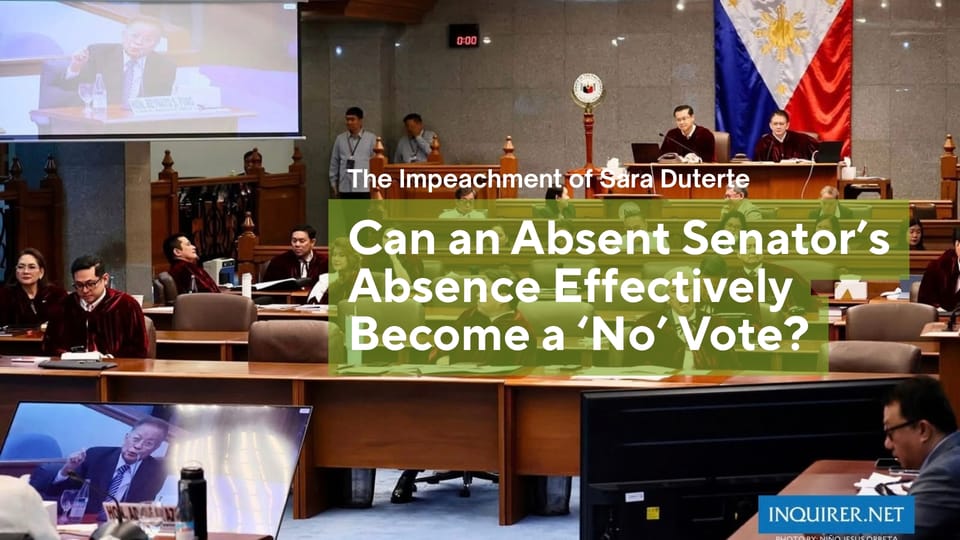
MANILA — Usa sa pinakadakong legal questions sa impeachment trial ni Vice President Sara Duterte mao kung ang absence sa usa ka senator-judge mahimong makaapekto sa number of votes nga gikinahanglan para sa conviction.
The issue became more important after retired Supreme Court justices gave different views on how the voting threshold should be counted.
ANG 16-VOTE RULE
Under the Constitution, conviction in an impeachment case requires the concurrence of two-thirds of all the Members of the Senate.
With 24 senators, this has traditionally been understood as 16 votes.
Pero karon, gipangutana kung ang mga senator nga wala naka-participate sa trial dapat ba gihapon iapil sa basehan sa computation.
ABSENT SENATOR = NO VOTE?
Technically, ang absence dili parehas sa “No” vote.
Kung dili motambong ang usa ka senator sa final voting, wala siya nag-cast og “No.” Wala lang siya nakaboto.
Apan adunay importanteng epekto kung fixed gihapon ang 24 senators isip denominator.
Pananglitan, kung 16 votes gihapon ang gikinahanglan bisan adunay senators nga absent, ang mga wala mobotar dili makahatag og “No” vote mismo—but their absence means fewer senators are available to cast a “Yes” vote.
Mao kini ang reason nga adunay mga senador nga nag-ingon nga ang fixed 16-vote requirement could effectively make an absence work like a vote against conviction, bisan dili kini literal nga “No” vote.
PANGANIBAN: FAIRNESS ISSUE
Former Chief Justice Artemio Panganiban questioned whether senators who did not participate in the trial should still be included when determining the votes needed for conviction.
Matud niya, fairness in judgment could be based on the senators who are actually present and participating in the proceedings.
AZCUNA: SENATOR PA GIHAPON
Lahi ang view ni retired Supreme Court Associate Justice Adolfo Azcuna.
His position, as reported during the Senate proceedings, is that if a person remains a senator, that senator remains part of the Senate for purposes of the constitutional two-thirds requirement. Simple absence does not automatically remove the senator from the calculation.
WHY THIS MATTERS
Dili lang ni ordinary mathematical problem.
Ang issue touches on who should be counted, how “two-thirds” should be understood, and whether participation in the trial should affect the final voting threshold.
The retired justices invited by the Senate impeachment court did not give exactly the same interpretation, showing that the issue remains legally contested.
THE BIG QUESTION
Kung ang senator wala motambong ug wala mobotar, dapat ba siya iapil gihapon sa 24-member basehan?
Or should the required votes be based only on the senators who actually participate in the final decision?
For now, the Senate impeachment court still has to determine how the constitutional two-thirds requirement will be applied to the final vote.
One thing is clear: absence itself is not a “No” vote—but depending on how the threshold is calculated, it can affect the number of “Yes” votes needed for conviction.